Civil funerals and burial for non-members
In short
A non-member has a legal right to a grave at the home parish cemetery, on request in a non-denominational area, at member fees. Instead of a blessing, a civil officiant, relative or friend leads a farewell ceremony in a chapel, graveside or rented room. Non-members pay Helsinki's chapel fee: 400 euros weekdays, 630 Saturdays. A pastor is possible on request.
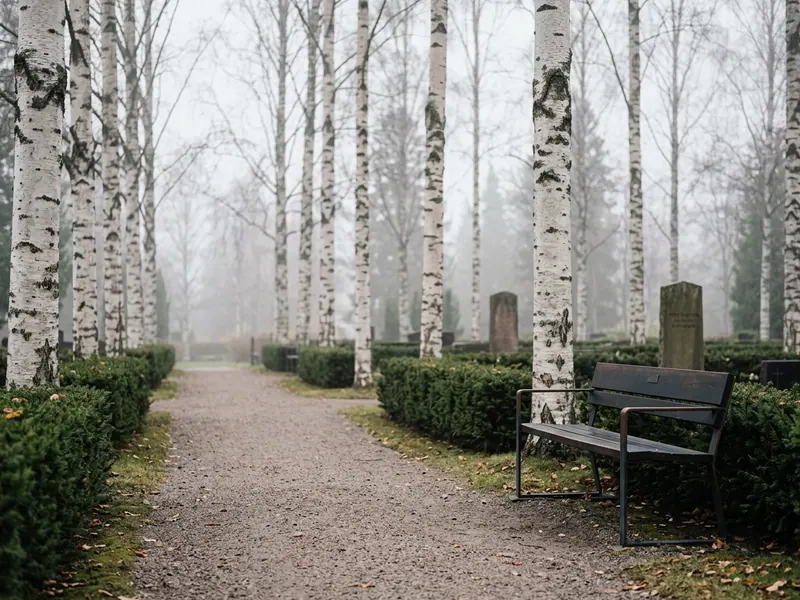
The right to a grave and the non-denominational area
The Funeral Act obliges the Evangelical Lutheran parish or parish union to provide a grave to everyone whose home municipality lies in its area, regardless of whether the deceased was a church member. By law, parish cemeteries are general cemeteries. On request, the grave must be given in a separate non-denominational area without religious symbols. In Helsinki the non-denominational area is at Honkanummi cemetery, which offers both urn graves and other plots; in Espoo and Vantaa the grave is likewise provided at the home municipality's parish cemeteries. A new grave is granted only in connection with a death and is reserved through the parish burial services; you can authorise us to make the reservation. Not belonging to the church does not limit the form of burial: the deceased can be buried in a coffin or cremated, and the ashes placed in an urn grave, a memorial grove, a scattering area or a columbarium. The Funeral Act also requires that the deceased's own conviction and wishes are respected.
Grave fees are the same for everyone
Under the Funeral Act, the basis of the fees charged for a grave, burial and grave care must be the same for everyone entitled to be buried in that cemetery. Church membership therefore does not affect the price of the grave or the burial. The home municipality does: a non-resident pays more. The prices for a deceased Helsinki resident from 1 February 2026 are as follows.
- Cremation at the Malmi or Honkanummi crematorium 260 euros; at the Hietaniemi crematorium 320 euros
- Urn grave for 25 years 180 euros and placing the ashes 150 euros
- Memorial grove or scattering area 90 euros and placing the ashes 150 euros
- Hietaniemi columbarium 300 euros for 25 years and placing the ashes 150 euros
- Coffin burial for a Helsinki resident 690 euros; new coffin graves are given only to Helsinki residents
- Non-resident: cremation 500, placing the ashes 170, urn grave 310, memorial grove or scattering 150, columbarium 610 euros
The chapel fee for non-members
The only parish fee that depends on church membership is the fee for using the chapel or parish hall. At the Helsinki cemetery chapels, a ceremony for a deceased non-member costs 400 euros on weekdays and 630 euros on Saturdays; church members pay nothing. In Espoo, the non-member fee is 458 euros for the Espoo funeral chapel and 560 euros for the Kellonummi chapel. The fee is the same whether a pastor or a civil officiant leads the ceremony. The cemetery chapel is therefore available for a farewell ceremony without a pastor too, and it is the most common venue for a non-member's funeral, because the coffin is already there and no extra transport is needed. The chapel fee can be avoided by holding the ceremony directly at the grave or in another room. The parish union's invoice arrives after the ceremony, and we pass it on unchanged.
A pastor is possible on request
A non-member can be blessed at burial if the relatives or those arranging the funeral request it. The pastor then comes from the parish of the deceased's home district, and the blessing follows the same order as for a member; the pastor's work is free of charge. The deceased's own wish decides: if they said during their lifetime that they did not want a church blessing, that wish is followed even if the family would think otherwise. Likewise, a deceased who was a church member is entitled to a blessing even if the relatives are not members. If the wish is uncertain, consider what the deceased would have wanted and discuss it within the family. We help contact the parish if a blessing is requested. The order of the blessing is described in the guide on arranging the funeral blessing.
Who leads the farewell ceremony
When there is no pastor, the ceremony can be led by a civil officiant, a speaker, a relative or a friend. A civil officiant is an experienced speaker who meets the family beforehand, composes an address about the deceased's life and carries the ceremony through from start to finish; the officiant's fee is invoiced separately, and we tell you the amount before booking. A relative or friend suits as leader when someone in the family can speak and hold the programme together even in grief; we can then support them, handle the practical flow in the chapel and make sure the music is played. Choose the leader first, because the programme is built with them. We help find a suitable civil officiant and arrange a meeting between the officiant and the family.
Where the farewell ceremony is held
The venue depends on whether the coffin or the urn is present. A ceremony at the coffin is most practical in the cemetery chapel or directly at the grave, because transporting and handling the coffin belong to the funeral home and the parish. Bringing the coffin to a private rented room or a home is unusual and must be checked separately with the venue's holder and with us before we promise it. A ceremony at the urn is freer: after the cremation the urn can be taken to almost any room, and the ceremony can be combined with the urn lowering at the grave or in the memorial grove. Scattering the ashes outside a cemetery requires the permission of the landowner or the owner of the water area, and no memorial may be placed at the scattering site; the City of Helsinki has designated sea areas west of Harmaja and north-west of Rysäkivi for scattering.
- Cemetery chapel: the coffin is already in place, chapel fee for non-members
- Directly at the grave: a shorter programme, no chapel fee
- Rented room or home: most natural with an urn; bringing a coffin must be checked separately
- Outdoors at a scattering: landowner's permission, no memorial
The programme of the farewell ceremony
The farewell ceremony has no set form, so the programme is built around the deceased and the family. A working structure resembles the blessing: an opening, a speech, a moment of silence, the laying of flowers and a closing. The music can be recorded or live; the pieces are chosen to the deceased's taste. There can be one speech or several, and poems or readings fit well. Flowers are laid beside the coffin or urn at the start or the end, the closest family first. Below is an example order.
- Opening music
- The leader's words of welcome and introduction of the deceased
- A speech about the deceased's life
- A poem or a reading
- A moment of silence
- Laying of flowers, the closest family first
- Closing words and the invitation to the memorial gathering
- Closing music, during which the coffin is carried out or stays in place
Blessing, farewell ceremony and memorial gathering
The terms are easily confused, so here is the difference in brief. The blessing is a church service in which a pastor blesses the deceased; it lasts about half an hour and follows the church's order. The farewell ceremony is free of religious form: the family takes leave of the deceased at the coffin or urn, a person chosen by the family leads it and the programme is built freely. The memorial gathering follows either one and remembers the deceased with speeches, music and refreshments at home, in a restaurant or in a rented room. A civil funeral therefore usually consists of a farewell ceremony and a memorial gathering, and either can be left out. If the deceased is cremated directly without a ceremony at the coffin, the farewell ceremony can be held later at the urn. Arranging the memorial gathering is covered in its own guide.
What a civil funeral costs
The price of a civil funeral consists of the same parts as a church funeral: the coffin, any urn, transport, the grave and cremation, flowers, the ceremony venue and the memorial gathering. Not belonging to the church does not raise the price in itself; the extra costs are the chapel fee if the ceremony is held in a parish chapel, and the civil officiant's fee if a leader is hired. Our packages include the coffin, the urn, one transport in the Helsinki region, dressing, coordination of the ceremony and the arrangements with the parish and crematorium: Hillitty 1,290 euros, Klassinen 1,790 euros and Harmonia 2,590 euros. Parish and crematorium fees are passed on unchanged. The usual total for a funeral is between 2,500 and 5,000 euros; a direct cremation without a ceremony costs about 1,000 euros in the Helsinki region. We give a written estimate before anything is booked. Funeral costs are deductible in the estate inventory, and if needed, funeral assistance can be applied for from the wellbeing services county's social services.
What you can leave to us
We handle a civil funeral the same way as a church funeral: we collect and transport the deceased, forward the burial permit, reserve the grave and, if wanted, the non-denominational area, book the chapel or another room, arrange the cremation, help find a civil officiant, build the programme with you, order the flowers, play the music in the chapel and arrange the memorial gathering. You decide the form of burial, the place, the leader, the music and what is said about the deceased. Every choice, price and date is visible in the family's shared online space, where every relative sees the same information. Call 09 6129 890 or book a planning visit at Annankatu 12; the visit is free of charge. We also come to your home if needed, and we serve you in Finnish, Swedish and English.
Frequently asked questions
Can a non-member get a grave at a parish cemetery?
Yes. The Funeral Act obliges the parish to provide a grave to everyone whose home municipality lies in its area, regardless of membership. On request the grave is given in a non-denominational area; in Helsinki that is at Honkanummi. The grave fee is the same as for members and depends on the home municipality.
Is a funeral more expensive for a non-member?
Not substantially. By law the fees for the grave, cremation and burial are the same for everyone. The only difference is the chapel fee if the ceremony is held in a parish chapel: in Helsinki 400 euros on weekdays and 630 euros on Saturdays, in Espoo 458 or 560 euros. A civil officiant's fee is invoiced separately if a leader is hired.
Can a pastor bless a non-member?
Yes, if the relatives or those arranging the funeral request it. The pastor comes from the parish of the deceased's home district, and the blessing is free of charge. The deceased's own wish decides: if they declined a church blessing, none is held. The chapel fee is still charged for a non-member even when a pastor officiates.
Who can lead a civil funeral?
A civil officiant, a speaker, a relative or a friend. The civil officiant meets the family beforehand, writes a speech about the deceased's life and carries the ceremony through; the fee is invoiced separately. If the leader is a relative, we support them and handle the practical flow in the chapel. We help find a suitable officiant and arrange a meeting.
Can the farewell ceremony be held at home or in a rented room?
With an urn, yes: after the cremation the urn can be taken to almost any room. Bringing the coffin to a home or a private rented room is unusual and must be checked separately with the venue's holder and with us. With the coffin, the ceremony is most practical in the cemetery chapel or directly at the grave.
What is the difference between a blessing and a farewell ceremony?
The blessing is a church service that a pastor conducts according to the church's order; it lasts about half an hour. The farewell ceremony is a leave-taking at the coffin or urn free of religious form, led by a person the family chooses, with a freely built programme. Either can be followed by a memorial gathering.
Can the ashes be scattered in nature?
Yes, with the permission of the landowner or the owner of the water area. The City of Helsinki has designated sea areas west of Harmaja and north-west of Rysäkivi for scattering. No memorial may be placed at the scattering site. The placement is stated in writing to the crematorium when the urn is released, and the ashes must be placed in one location within a year of cremation.